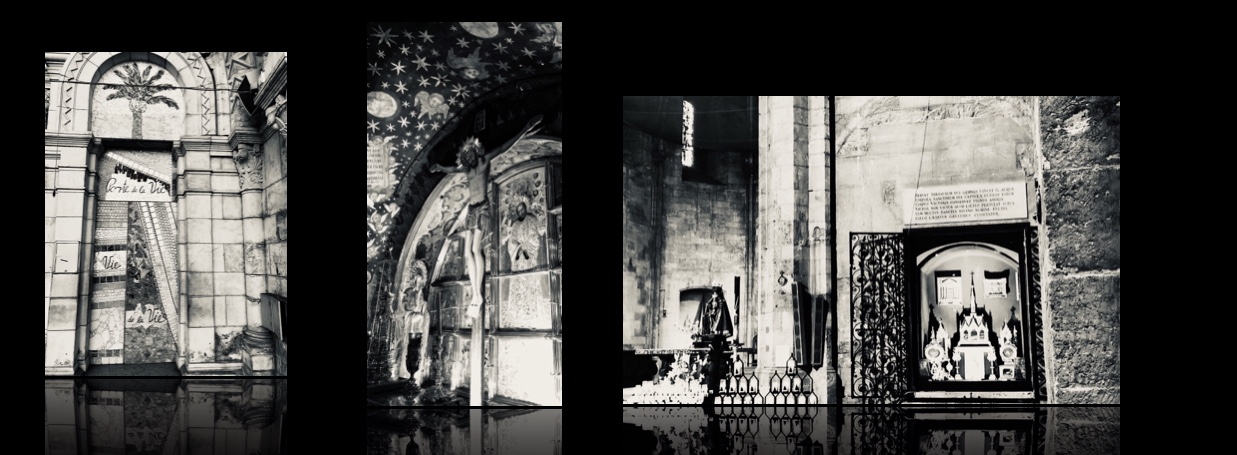

Saint Martin is one of the most famous saints, remembered and honored every year on the 11th November. And because he was the third bishop of Tours in France, he is the patron saint of the French people.
For his feast day I‘d like to share with you a few excerpts from Jacobus de Voragine‘s Golden Legend…
What the Golden Legend tells us about his childhood and youth
“Martin was born in the town of Sabaria in Pannonia but grew up in Pavia, Italy, with his father, who was a military officer. Martin served in the army under the caesars Constantine and Julian, but a military career was not his own choice. Even in childhood he was inspired by God, and at the age of twelve, against his parents‘ wishes, he fled to a church and asked to be accepted as a catechumen. He would have become a hermit, but his youth and lack of bodily strength forbade it. Then the caesars decreed that the sons of veterans should take their fathers‘ places in the legions. Martin was pressed into service at the age of fifteen, with only one man to serve him, although more often it was Martin who took off his man‘s boots and cleaned them.
Jacobus de Voragine: The Golden Legend. Readings on the Saints, Princeton University Press 1993, p. 678-679
Once, in the wintertime, he was passing through the city gate of Amiens when a poor man, almost naked, confronted him. No one had given him an alms, and Martin understood that this man had been kept for him, so he drew his sword and cut the cloak he was wearing into two halves, giving one half to the beggar and wrapping himself in the other. The following night he had a vision of Christ wearing the part of his cloak with which he had covered the beggar, and heard Christ say to the angels who surrounded him: ‘Martin, while still a catechumen, gave me this to cover me.‘ The holy man saw this not as a reason for pride, but as evidence for God‘s kindness, and had himself baptized at the age of eighteen. Moreover, he stayed in the army for two years more at the urging of his superior officer, who promised that when his term of office expired, he too would renounce the world.
At that time the barbarians were breaking through the empire‘s frontiers, and Emperor Julian offered money to the soldiers who would stay and fight them. Martin had had enough of soldiering and refused the profferred bonus, saying to the emperor: ‘I am a soldier of Christ, and I am forbidden to fight.‘ Julian was indignant and said that Martin was refusing not for motives of religion but because he was afraid of getting into a war. Martin, who knew no fear, retorted: ‘If my refusal is attributed not to faith but to cowardice, I will stand forth tomorrow morning at the line of battle, unarmed, and, in the name of Christ, protected not by shield or helmet but by the sign of the cross, shall walk safely through the enemy‘s lines.‘ He was put under guard immediately to ensure that he would face the barbarians unarmed, as he had said. But the next day the enemy sent legates to convey their surrender of all men and materials, so there can be no doubt that this bloodless victory was due to the holy man‘s merits.“
What the Golden Legend tells us about his character
“Martin was a man of deep humility. In Paris he once came face to face with a leper from whom all shrank in horror, but Martin kissed him and blessed him, and he was cured. His dignity was great: he was said to be equal in dignity with the apostles, and this due to the grace of the Holy Spirit, who descended upon him in the appearance of fire to strengthen him, as had happened to the apostles. (…)
Jacobus de Voragine: The Golden Legend. Readings on the Saints, Princeton University Press 1993, p. 681-683
He was very just, giving to each his due. Once when he was invited to dine by Emperor Maximus, the cup was offered first to Martin, and everyone expected that he in turn would pass it to the king. But he passed the cup to the priest who was with him, considering no one more worthy to drink after the bishop, and deeming it unjust to put the king or the king‘s close associates ahead of a priest.
His patience was inexhaustible and was maintained in all circumstances. Even though he was the priest highest in rank, his clerics often treated him rudely without being reprimanded, nor did he for that reason exclude them from his charity. No one ever saw him angry, nor grieving, nor laughing. Nothing was heard from his lips but Christ, never was aught in his heart but piety, peace, and mercy. (…)
He was assiduous in prayer. Indeed, we read in his legend that no hour or minute passed which he did not devote either to prayer or to sacred reading. Whether at work or at reading he never took his mind from prayer. (…)
He lived a very austere life. Severus, in a letter to Eusebius, tells how Martin once stopped overnight at a villa in his diocese, and the clergy there prepared for him a bed with a mattress filled with straw. When he lay down on it, he shuddered at the unaccustomed softness, since he usually slept on the floor with only a single hair cloth over him. Unhappy at this unintended misunderstanding, he rose, threw aside all the straw, and stretched out on the bare ground. (…)
His compassion for sinners was unbounded. He took to the bosom of his merciful understanding all who wished to repent. The devil himself took issue with Martin for admitting to penance those who fell once, and Martin answered: ‘If you yourself, poor wretched being, would stop trying to bring men down, and would repent of your deeds, I, trusting in the Lord, would promise you Christ‘s mercy!‘“
There was no limit to his compassion for the poor. The Dialogue tells us that Martin was on his way to the church for the celebration of some feast and was followed by a poor man who was just about naked. The bishop asked the archdeacon to find some clothes for the man, but the archdeacon deferred doing this, and Martin went into the sacristy, took off his tunic, gave it to the beggar, and told him to be off. The archdeacon then advised the bishop to proceed with the ceremony, but Martin said that he could not go ahead until the poor man – meaning himself – got some clothes to wear. The archdeacon did not understand, since the bishop was wrapped in his cope and the other could not see that he had nothing under it, and anyway, he observed, there was no poor man there. ‘Fetch me a tunic,‘ Martin said firmly, ‘and then there will be no poor man here looking for clothes!‘ The archdeacon, resentful, went to the marketplace and for five coins bought a cheap, short tunic (…). Angrily he threw the garment at Martin‘s feet. The bishop went behind a screen, put the tunic on – the sleeves coming only to his elbows and the lower edge only to his knees – and, so vested, went on to celebrate the mass. While he was celebrating, a globe of fire appeared over his head and was seen by many people. (For this reason Martin is said to be on a par with the apostles.) (…)
Martin displayed much power in driving out demons and often did expel them from the possessed. (…) Martin had a subtle sense for discerning demons. No matter what form, image, or disguise they assumed, he saw them openly and uncovered.“
What the Golden Legend tells us about his death
“Martin knew the time of his death well in advance and revealed it to his brothers. (…) When he had spent some time in the above-named diocese, his strength began to fail, and he told his disciples that his days were numbered. They wept and asked him: ‘Why are you deserting us, father? To whom are you leaving us, orphans? Fierce wolves will ravage your flock!‘ Moved by their entreaties and tears, Martin wept with them and prayed: ‘Lord, if I am still needed by your people, I do not refuse the labor! Thy will be done!‘ He really was not sure which he preferred, because he wanted neither to leave these people nor to remain separated from Christ any longer. Therefore when fevers racked him for some time and his disciples asked him to let them put some straw in the bed where he lay in sackcloth and ashes, he said: ‘My sons, the only proper way for a Christian to die is in sackcloth and ashes. If I leave you any other example, I shall have sinned.‘ His eyes and his hands he kept always pointed to heaven, and never let his unconquered spirit slacken in prayer. He lay always on his back, and when his priests begged him to let them ease his poor body by turning him on his side, he said: ‘Leave me as I am, brothers! Let me keep my eyes on heaven rather than on earth, so that my spirit may always be directed toward the Lord!‘ Even as he said this, he saw the devil standing by and said: ‘What are you here for, bloody beast? You will find nothing deadly in me, and Abraham‘s bosom will welcome me!‘ And with these words, in the reign of Arcadius and Honorius, which began about A.D. 395, and in the eighty-first year of his life, he yielded his spirit to God. His face shone as though he was already glorified, and many heard choirs of angels singing around him.“
Jacobus de Voragine: The Golden Legend. Readings on the Saints, Princeton University Press 1993, p. 684

Saint Martin of Tours, pray for us!